
BOONE, N.C. — Appalachian State University research starts high in our watershed and flows down to mountain communities and beyond, informing policy, practice, and a greater understanding of interconnection. The New River is a learning laboratory for student-engaged inquiry linking researchers across disciplines.
App State faculty are working to understand how severe storms shape the land, water, and even human health. They are gathering data on flooding impacts on habitat change, soil leaching, and well water quality, and devising new tools and methods to monitor future extreme weather events in real time.
“The ongoing focus on the Upper South Fork New River, due to its proximity to App State, is playing a huge role in forwarding our understanding of headwater ecosystems and responses to development, population growth, and climate change impacts in Appalachian watersheds,” said Dr. Shea Tuberty, professor in the Department of Biology.
Tuberty leads headwaters research on the recovery and response of mountain stream aquatic macroinvertebrates to Hurricane Helene’s flooding impacts. He also researches the benefits of watershed restoration led by numerous nonprofit community organizations. Elbow-to-elbow with student researchers, Tuberty has found encouraging signs in Hardin Creek, which passes behind Watauga High School before emptying into the south fork of the New River.
“We just determined that there are now 19 species of fish in the creek, compared to 2011 when there were only 11 species,” Tuberty said. “That’s a 72% increase in species numbers based just on fish.”
Research in the river spans disciplines from data science to chemistry to geological and environmental sciences, and geography and planning. Data streams emerging from the watersheds are being used by NASA to monitor greenhouse gas emissions from Appalachian mountain streams and improve the agency’s efforts to model current and changing emissions using satellite-based observations.
“We recently submitted a paper to the Bulletin of the American Meteorological Society that proposes a framework to synthesize ground-based and space-based observations in the Appalachian region,” said Dr. Dustin Roten ’15 ’18, an assistant professor in the Department of Physics at Utah Valley University, who is leading the project in collaboration with Tuberty.
A new eye on flooding
App State faculty are collaborating on a novel initiative linking computer science, geological and environmental sciences, and geography to develop a practical, low-cost tool for monitoring the highly localized risks of mountain flooding, providing hands-on interdisciplinary research opportunities for students in those areas. The pilot project is led by Dr. Mohammad Ali Javidian, assistant professor in the Department of Computer Science. Co-principal investigators are Dr. Derek Martin, interim chair of the Department of Geography and Planning, and Dr. William P. Anderson Jr., professor in the Department of Geological and Environmental Sciences.
“Mountain streams can rise quickly, and it is neither practical nor affordable to install permanent measurement equipment at every vulnerable location,” Javidian said. “Our project will use advanced artificial intelligence and machine-learning models to transform streamside video and water-level data into reliable, near-real-time estimates of surface velocity and discharge.”
The team will gather data and test the technology in the Upper South Fork of the New River in fall 2026 and spring 2027, helping build the foundation for supporting better flood awareness and preparedness in mountain communities, Javidian said. The researchers hope to use the seed project to generate preliminary results, field protocols, and a collaborative research record to support a funding proposal to the National Science Foundation.
Stories of the watershed
New River research extends into the realm of storytelling, place, and culture, crossing time to unearth common narratives and share them in publications, exhibits, talks, and venues such as the annual New River Symposium and through the work of faculty affiliated with the Center for Appalachian Studies, where creative work ranges from art exhibits to documentaries unearthing narratives of enduring culture and resilience in the face of adversity.
Dr. Alice Wright studies the deep history of the upper New River and the traces of activity left by Native Americans as early as 10,000 years ago. Wright, a professor in the Department of Anthropology, and her student researchers have spent the last several years examining artifacts gathered across Ashe and Alleghany Counties in the 1970s during environmental impact surveys for the Blue Ridge Dam project, which was eventually cancelled.
With a goal of preservation, celebration, and increased educational opportunities, Wright explained, her research into archaeological sites and Indigenous heritage aims to “help us imagine different ways of living on and with the river today.”
###
About the Office of Research and Innovation
Appalachian State University’s Office of Research and Innovation supports the scholarly and creative activities of App State faculty, staff, and students by expanding access to and facilitating the management of research opportunities. The office consists of four units: Grants Resources and Services, Sponsored Programs, Research Design and Analysis, and Research Protections. The office also collaborates with the university’s Special Funds Accounting on the fiscal management of awarded projects. Learn more about the Office of Research and Innovation
About the College of Arts and Sciences
The College of Arts and Sciences (CAS) at Appalachian State University is home to 17 academic departments, two centers, and one residential college. These units span the humanities and the social, mathematical, and natural sciences. CAS aims to develop a distinctive identity built upon our university's strengths, traditions, and locations. The college’s values lie not only in service to the university and local community, but through inspiring, training, educating, and sustaining the development of its students as global citizens. More than 6,800 student majors are enrolled in the college. As the college is also largely responsible for implementing App State’s general education curriculum, it is heavily involved in the education of all students at the university, including those pursuing majors in other colleges. Learn more about CAS
Written by Bret Yager
September 15, 2026
BOONE, N.C.
Three people examine papers and a plastic container while sitting on rocks beside a stream; others stand in the background near trees and water.
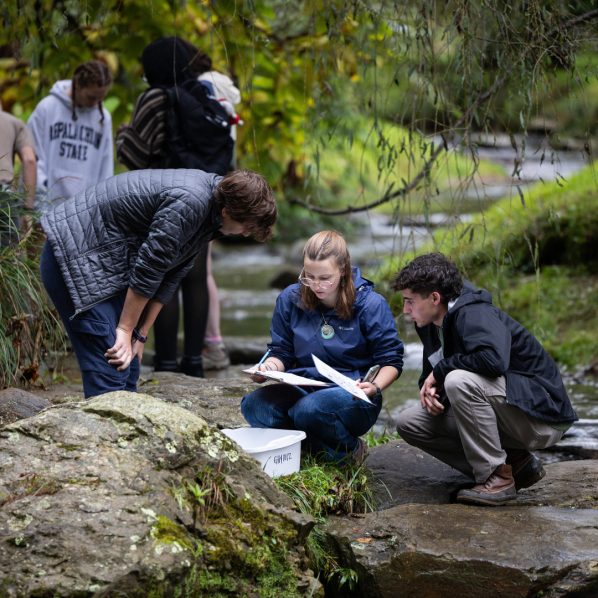
App State geography students conduct research in Boone Creek, a tributary of the New River watershed. Photo by Chase Reynolds