Mountaineer Discovery: This story is part of a series highlighting student research, creativity and innovation at App State. Join the Office of Student Research for the 29th annual Celebration of Student Research and Creative Endeavors on Wednesday, April 22.
Savannah Devine ‘22 graduated from App State with a passion for exploring the land under our feet. Because so many geological processes are buried too deeply to be directly observed in real time, a lot of work lies ahead to study, understand, and eventually model the forces within the Earth — advances with big implications for science, resource extraction, and human safety. Devine aims to be in the thick of it.
A graduate of the Department of Geological and Environmental Sciences, Watauga Residential College, and the CAS Corps, Devine is a Ph.D. student at the University College Dublin School of Earth Sciences, where she focuses on the use of numerical modeling to better understand the collapse of volcanic calderas and cascade of effects those events have on earthquakes and the progression of eruptions.
Numerical models allow researchers to study and simulate magma movements, ground deformation, pressure, and earth stresses in volcanically active areas — without having to actually be in the vicinity. Devine received the 2024 Jane Grimson Medal of Excellence, a prestigious award given by Research Ireland to recognize the country’s top postgraduate researchers in STEM.
For this Q&A, we caught up with Devine, originally of Polk County, to get a glimpse into her work and the volcanic world.
Your focus involves numerical modelling of the collapse of volcanic calderas. Why is this an important area to study, and what do you hope to accomplish with your work?
“Calderas form when magma quickly ejects from the magma chamber, causing the roof to collapse and form a bowl-like structure. These are high-energy events that can result in fatalities for nearby populations. Luckily, they rarely occur. However, in terms of understanding them, the lack of these events also means that we don’t have a ton of data to go off of. This means that when these events occur in the future, it can be difficult to know what to expect and how to keep nearby populations safe.
I hope to successfully replicate behaviors we see in observations of collapse events, allowing for a detailed and accurate model that can be applied to multiple cases. The models can be used to tell us what to expect in future events — like where the most damage is likely to occur, where people need to evacuate and what geological behaviors indicate a possible eruption or collapse."
How did you become interested in volcanoes?
“I find natural disasters fascinating. I was surprised when I was starting out in geology just how little we know about these kinds of hazardous events. Even in places where you'd expect the most research to happen — Southern California for earthquakes or Yellowstone for volcanoes — there really is so much left to do. We still can't really predict these things, and detailed observations like the ones we see today weren't possible until recent decades. Modeling uses a ton of computing power. As a result, a lot of the modelling techniques used today were also not possible until fairly recently. There's so much left to learn, and I'm excited to be a part of it."
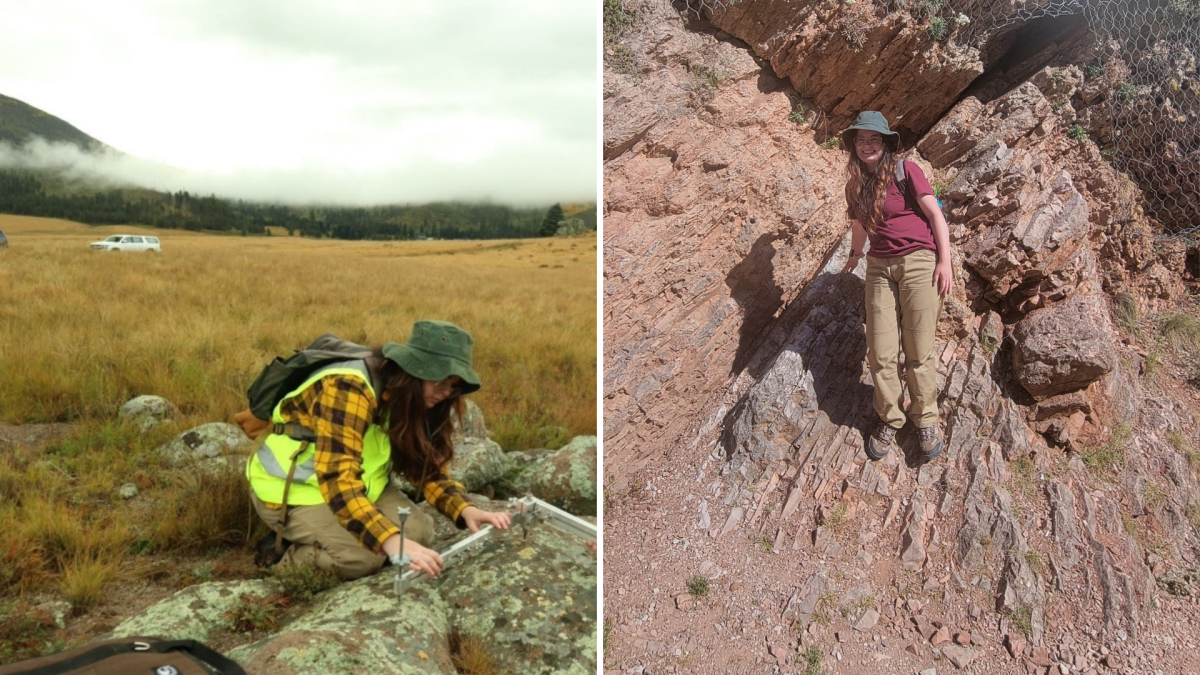
Left: Savannah Devine ‘22 installs a temporary GPS station in the Valles Caldera, Northern New Mexico, as part of her geological research. Right: Savannah Devine ‘22 stands on the K-Pg boundary, a site in Italy that marks where the Cretaceous Period ended and the Paleogenic began, during a 2022 field camp with the Department of Geological and Environmental Sciences. Photos submitted
Did your undergraduate research at App State help position you for the Jane Grimson Medal of Excellence?
“I have been very lucky in the research opportunities I have received. During my time at Appalachian State, I was able to complete and publish work around the faults in and surrounding Los Angeles. I also completed two internships — one with the Southern California Earthquake Center, now the Statewide California Earthquake Center, in work that was published. I was looking at the Ridgecrest Earthquake and the damage caused to Trona Pinnacles National Monument. I also had an internship with EarthScope, a National Science Foundation program using integrated studies across the earth sciences to understand the North American continent in 4D. I looked at dynamic rupture models of the Cascadia Subduction Zone, a megathrust fault buried on the ocean floor off the Pacific Northwest coast, capable of producing devastating earthquakes and tsunamis. I really enjoyed this internship, and I presented this work at my first American Geophysical Union meeting.
I believe these experiences had a large impact on my ranking within the scholarship framework."
What undergraduate experiences, research projects, programs or faculty were most memorable?
“I worked with Dr. Scott Marshall, professor of geophysics in the Department of Geological and Environmental Sciences, throughout the majority of my time at Appalachian State, and I learned a lot during that time. That was really my first introduction into any kind of geoscience, as well as participating in original research. I looked at the transverse and peninsular ranges of Southern California, modelling the faults in the region. This work ended up getting published, which was super exciting.
I was also part of the CAS Corps, which helped me become more confident in public speaking and communicating what I do to people outside of my field. I still love outreach, so this was something I chose to continue even after my time at Appalachian. I was a member of Watauga Residential College, and I’m still in contact with a lot of those same people to this day."
So, what’s next?
“Short term, knowing the pros and cons of the different types of numerical models allows me to better formulate why past models have room for improvement, why these improvements are important, and how I plan to change the existing models.
Longer term, I would like to finish my Ph.D., hopefully do a postdoc, and eventually become a professor. I love teaching and I love research. So hopefully, I will be able to work as a university professor and do both."
###
About the Department of Geological and Environmental Sciences
Located in Western North Carolina, Appalachian State University provides the perfect setting to study geological and environmental sciences. The Department of Geological and Environmental Sciences provides students with a solid foundation on which to prepare for graduate school or build successful careers as scientists, consultants and secondary education teachers. The department offers six degree options in geology and two degree options in environmental science. Learn more at earth.appstate.edu.
About the Watauga Residential College
The Watauga Residential College is a specialized academic program where classes are discussion-based seminars that allow students to pursue topics of interest to them within the context of the class. This program provides an unusual opportunity for students to become engaged in learning at a deep level through class discussions and research projects. Watauga classes are interdisciplinary and this approach to learning requires students to integrate knowledge from a variety of disciplines to gain a complete perspective on a topic. Learn more at watauga.appstate.edu.
About the College of Arts and Sciences
The College of Arts and Sciences (CAS) at Appalachian State University is home to 17 academic departments, two centers and one residential college. These units span the humanities and the social, mathematical and natural sciences. CAS aims to develop a distinctive identity built upon our university's strengths, traditions and locations. The college’s values lie not only in service to the university and local community, but through inspiring, training, educating and sustaining the development of its students as global citizens. More than 6,800 student majors are enrolled in the college. As the college is also largely responsible for implementing App State’s general education curriculum, it is heavily involved in the education of all students at the university, including those pursuing majors in other colleges. Learn more at cas.appstate.edu.
By Bret Yager
March 23, 2026
BOONE, N.C.
Savannah Devine ‘22
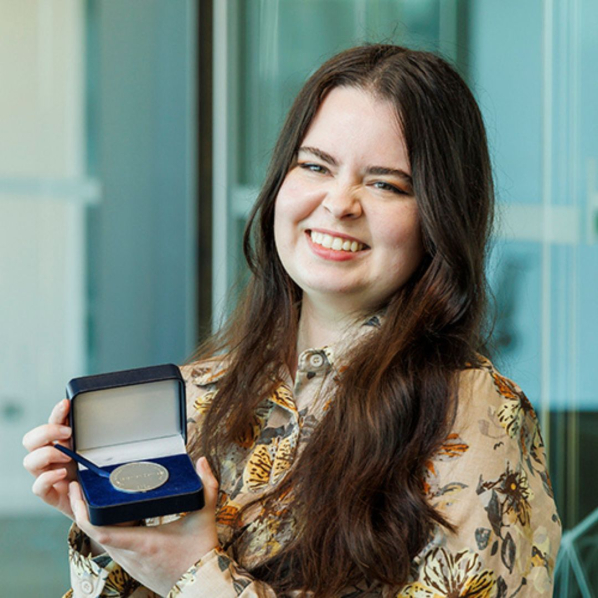
Savannah Devine ‘22 received the 2024 Jane Grimson Medal of Excellence, a prestigious award given by Research Ireland to recognize the country’s top postgraduate researchers in STEM. Photo submitted