BOONE, N.C. — Each summer, Appalachian State University's College of Arts and Sciences (CAS) awards $5,000 grants to untenured, tenure-track faculty to support scholarly research, creative projects, and external funding proposals.
This year, 17 faculty members received awards, and four recipients agreed to share their work publicly. Their projects reflect the college's breadth — spanning computer science, history, literature, and psychology — and demonstrate how dedicated summer support helps early-career faculty make meaningful progress on scholarly work.
Dr. Mohammad Ali Javidian (Computer Science)
Assistant Professor Mohammad Ali Javidian, who joined App State in 2022, used his CAS Summer Grant to accelerate "RiverCam AI: Real-Time River Discharge Estimation from Surface Imagery for Flood Resilience," an interdisciplinary project that blends computer science, environmental science, and geography. The project aims to turn simple riverside cameras into real-time flow gauges, providing communities with faster, more accessible flood‑related information.
The grant provided protected time for Javidian to work with a graduate student on early AI model development. Together, they implemented and evaluated several approaches using USGS river data, contributing to an abstract submitted to the 2026 AGU Annual Meeting. This collaboration reflects the college's commitment to involving students in meaningful research experiences.
The summer also led to new external funding: a FY27 CONCERT Research Grant that will support field data collection, student involvement, and model validation throughout the academic year. The CONCERT project will provide the evidence and field data needed to strengthen a future multi-institution submission.
Javidian's summer work broadened the project's scope. He collaborated on a climate‑focused immersive media proposal and served as a Research Theme Leader for the 2026 Water Prediction Innovators Summer Institute, where he helped evaluate machine-learning approaches for improving NOAA's National Water Model. He noted that these collaborations "broadened the RiverCam AI research agenda" and strengthened the foundation for future externally funded work.
Over the next several years, Javidian plans to expand field validation, deepen partnerships with hydrologists and emergency-management stakeholders, and pursue additional publications and funding opportunities.
Dr. Doris Morgan Rueda (History)
Assistant Professor Doris Morgan Rueda, who joined App State in 2025, used her CAS Summer Grant to advance her book project, Juan Crow Juvenile Justice: Doing Time in the Arizona Borderlands, 1907–1967, currently under contract with NYU Press. A historian of socio‑legal systems, childhood, and Latinidad in the United States, she examines how juvenile justice developed in rural regions of the American West and how local communities shaped legal practices over the 20th century.
The grant enabled a focused research trip to Tucson, Arizona, where Morgan Rueda worked extensively in the Arizona Historical Society's archives. She described the trip as "incredibly successful," noting that she gathered material "critical to the completion of my project" and connected with local experts who helped refine her historical approach. The uninterrupted time also allowed her to complete archival work that had been difficult to schedule during her first year on campus, which included a cross‑country move and a full teaching load.
A key discovery came when an archivist located a collection documenting the experiences of girls in Arizona's juvenile justice system — records she had not been able to find in previous trips. She wrote that this archival trove "allows me to include the direct voices of Latinx girls into the project," adding depth and nuance to the manuscript and strengthening her analysis of how young people navigated legal systems in rural borderland communities.
With her archival research complete, Morgan Rueda is now in the final writing and revision stages of her book, which she plans to submit at the end of the semester.
Dr. Brittany Roberts (English)
Assistant Professor Brittany Roberts, who joined App State in 2023, used her CAS Summer Grant to advance her book project, Becoming-With: Ecological Ethics and the More-Than-Human Worlds of Russian and American Horror. Her research examines how horror literature and cinema from both cultures foreground human relationships with the natural world and nonhuman animals, especially in moments of environmental crisis.
The grant enabled Roberts to develop a chapter of her book devoted to Aleksandr Sokurov’s film Days of Eclipse, which will also be published in the forthcoming collection The Intellect Handbook of Cinema and the Anthropocene. The chapter complements existing interpretations of the film by tracing its rich ecological subtexts, showing how the film challenges anthropocentrism, or the tendency to center the human, by emphasizing all humans’ ecological relationships with the nonhuman planet.
During the grant period, Roberts also completed a second project focused on technology, environmentalism, and the science fiction of early Soviet Russian writer Andrei Platonov. This work, which will be published as a chapter in the forthcoming collection The Liverpool Handbook of Environmental Science Fiction, represents one of the first English-language studies of Platonov’s science fiction and directly informs another of Roberts’s larger, long-term projects on the cultural and political significance of Soviet science fiction.
Over the next several years, Roberts will expand her research in the fields of environmental humanities, animal studies, horror and science fiction studies, and world literature and cinema by submitting her first book on Russian and American ecohorror and by continuing to develop her second project on Soviet science fiction.
Dr. Cassidy Sandoval (Psychology)
Assistant Professor Cassidy Sandoval, who joined App State in 2024, used her CAS Summer Grant to advance “Mind, Body, and Bump: Exploring Perinatal Body Image and Eating Behaviors,” a quantitative study examining health-related factors during pregnancy. Her work addresses important questions about how individuals experience body image changes and related behaviors during the perinatal period.
The summer allowed Sandoval to complete data cleaning, codebook creation, and analyses — major steps that enabled multiple scholarly products. She worked with graduate students to prepare three submissions to the Society for Behavioral Medicine’s annual meeting, each exploring different aspects of perinatal health, including comorbid disordered eating and gastrointestinal symptoms, patient-provider communication about body image, eating behaviors, and weight during prenatal care, and associations between weight-related attitudes and perinatal mental health.
The grant also supported a peer-reviewed publication in Eating Behaviors that was led by one of her graduate students, along with substantial progress on two additional manuscripts. Sandoval emphasized that the summer provided valuable time for student mentorship and fostering collaborative working relationships, noting that “all submitted abstracts and manuscripts (both published and in progress) have student co-authors and/or collaborators from other departments or institutions.”
A new direction emerged when she was invited to collaborate on a meta-analysis examining correlates of body dissatisfaction during pregnancy, work she completed alongside her primary project. Looking ahead, Sandoval plans to finish multiple manuscripts, present at the Society of Behavioral Medicine's annual meeting in 2027, and pursue external funding to support a project about positive body image in pregnancy.
The CAS Summer Grants program continues to demonstrate how protected research time helps early-career faculty make progress on major scholarly projects. This year's recipients advanced book manuscripts, developed new research tools, mentored students, secured external funding, and contributed to national and international scholarly conversations. Their work reflects the range of disciplines within CAS and the value of investing in faculty at pivotal career stages.
###
About the College of Arts and Sciences
The College of Arts and Sciences (CAS) at Appalachian State University is home to 17 academic departments, two centers, and one residential college. These units span the humanities and the social, mathematical, and natural sciences. CAS aims to develop a distinctive identity built upon our university's strengths, traditions, and locations. The college’s values lie not only in service to the university and local community, but through inspiring, training, educating, and sustaining the development of its students as global citizens. More than 6,800 student majors are enrolled in the college. As the college is also largely responsible for implementing App State’s general education curriculum, it is heavily involved in the education of all students at the university, including those pursuing majors in other colleges. Learn more about CAS
By Lauren Gibbs
September 16, 2026
BOONE, N.C
Four smiling adults in a 2x2 portrait collage: one man and three women, dressed professionally against black, purple, and textured backgrounds.
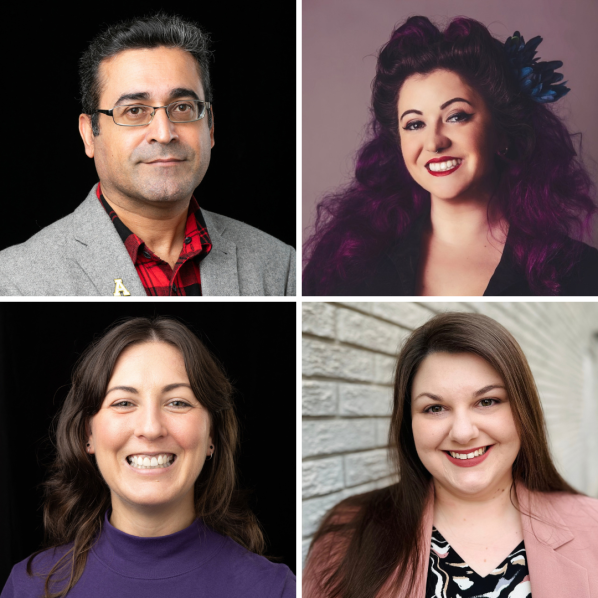
Dr. Mohammad Ali Javidian (top left), Dr. Doris Morgan Rueda (top right), Dr. Brittany Roberts (bottom left), and Dr. Cassidy Sandoval (bottom right) received CAS Summer Grants in 2026.