
Mountaineer Discovery: This story is part of a series highlighting student research, creativity, and innovation at App State. Join the Office of Student Research for the 29th annual Celebration of Student Research and Creative Endeavors on Wednesday, April 22.
Students in Appalachian State University’s Biophysics and Optical Sciences Facility (BiyOSeF) are contributing to a range of multidisciplinary research projects that combine physics, biology, computer automation, and advanced optical instrumentation.
BiyOSeF was founded in 2010 by Dr. Brooke Hester ’02 ’04, professor and assistant chair in the Department of Physics and Astronomy, to advance knowledge in optical phenomena and biophysics, and to provide research opportunities to students.
Located in Garwood Hall, the facility houses a variety of advanced custom-built instruments that allow students to gain experience with designing and building advanced optical and electronic apparatuses. Students also have access to advanced equipment located in the facility, allowing them to build valuable technical skills that prepare them for the workforce. BiyOSeF has received external support from the National Institutes of Health, the North Carolina Biotechnology Center, the North Carolina General Administration, and the North Carolina Space Grant.
Hester, an optical physicist and App State alumna, mentors both undergraduate and graduate students as they take on roles that mirror the expectations of professional research environments. Students in the lab gain experience in instrument development, data collection and analysis, grant proposal writing, and scientific communication — skills that position them for their post‑graduate plans.
Junior physics major Chloe Thompson, of Mooresville, joined the lab after reaching out to Hester during her first year at App State. Thompson is currently working on setting up a spatial light modulator, a device used to shape laser beams, with the long‑term goal of integrating it into the lab’s optical tweezers system. “Our current goal is to get it operating so that it can produce arbitrary laser intensity distributions, but ultimately we would like to incorporate it into our optical tweezers,” she explained. Thompson, who plans to become an optical engineer, said the project has given her valuable exposure to optics‑focused research.
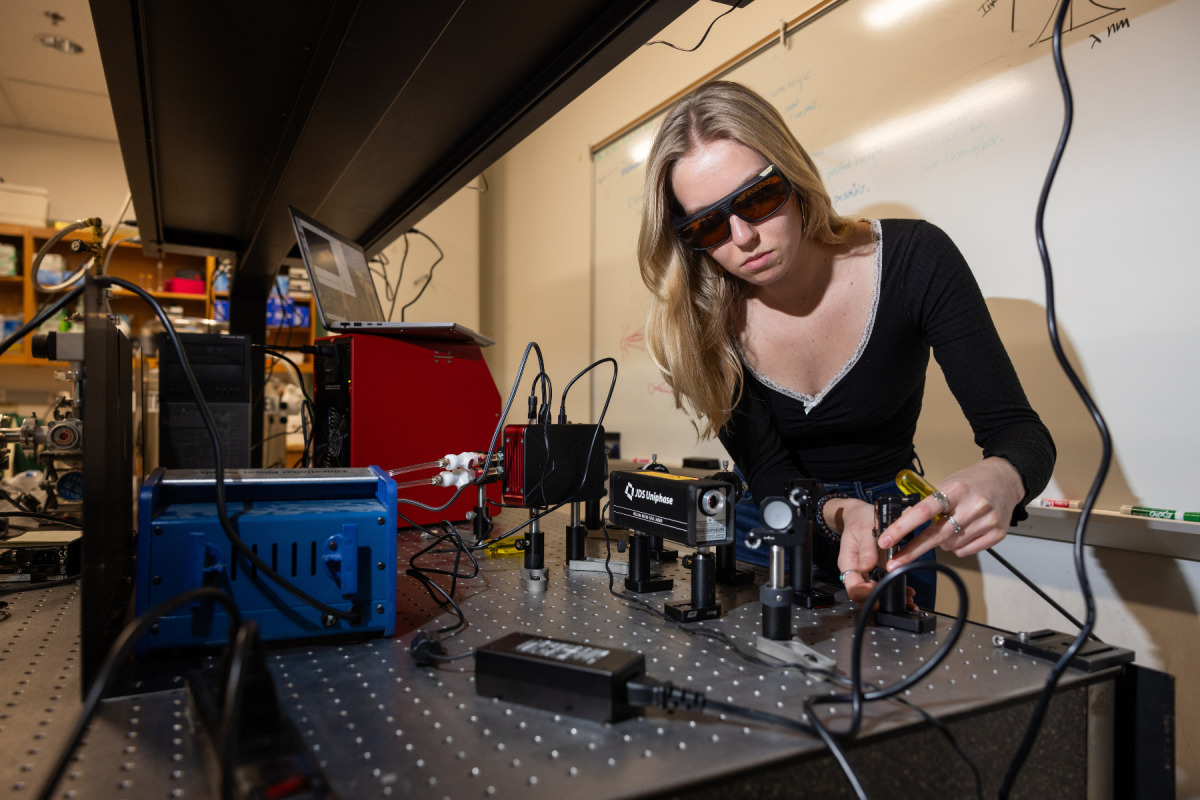
Junior physics major Chloe Thompson, of Mooresville, adjusts the laser pathway for the spatial light modulator. Photo by Chase Reynolds
Junior applied physics major Aidan Lindsey, of Asheville, became involved in the lab after learning about departmental research opportunities in a professional development course. She is currently training to work with optical tweezers, which use tightly focused laser beams to manipulate microscopic particles. Lindsey said she was drawn to working with the optical tweezers because of their applications to biomedical engineering and medical physics, fields she is interested in. “This research will help me build the skills and knowledge necessary to continue my education in a master’s program and work in a field which is likely heavily research‑based,” she shared.
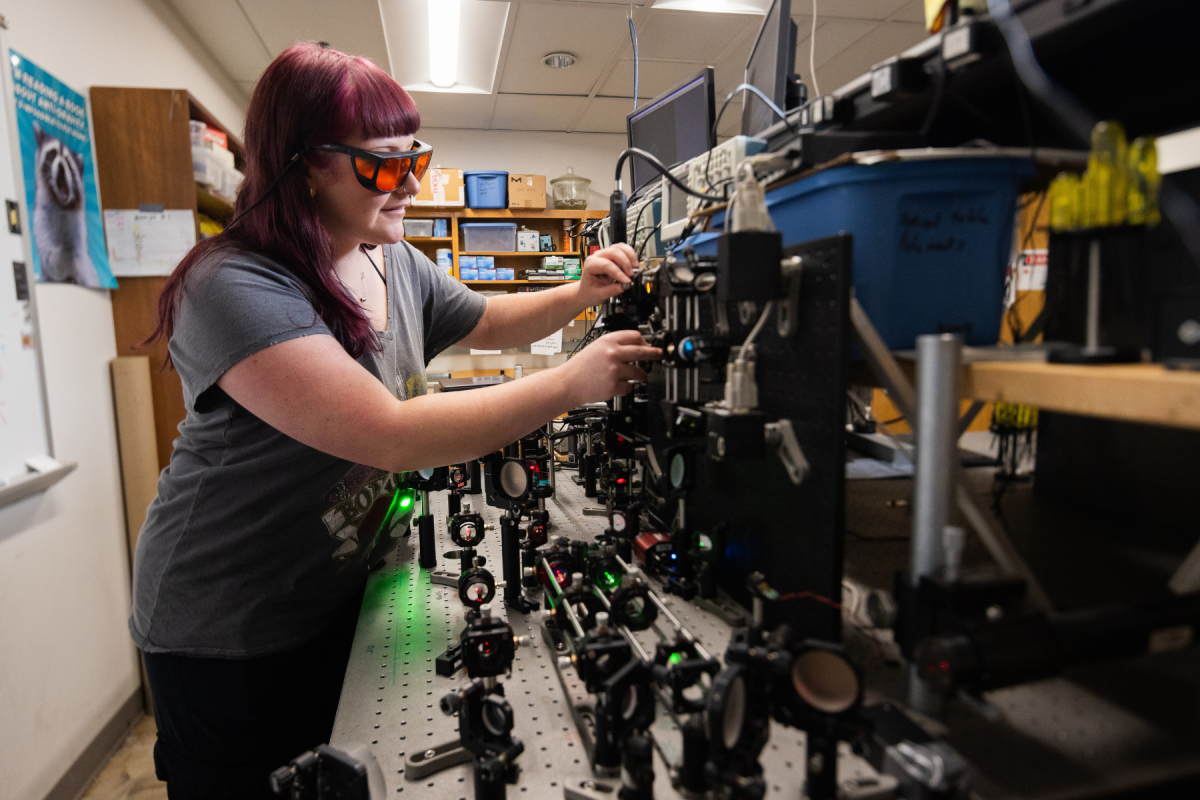
Junior applied physics major Aidan Lindsey, of Asheville, aligning one of the position detection lasers in the custom-built photonic force microscope and optical tweezers apparatus. Photo by Chase Reynolds
Junior physics major Joshua Lennon, of Greensboro, joined the lab after taking one of Hester’s courses and developing an interest in spectroscopy. He serves as a safety officer and works on the Laser Tweezers Raman Spectroscopy (LTRS) apparatus, which combines optical trapping with molecular analysis. “I like spectroscopy and the applications of it,” remarked Lennon, who plans to pursue a career in optical engineering and sees his work in BiyOSeF as an important step toward that goal.
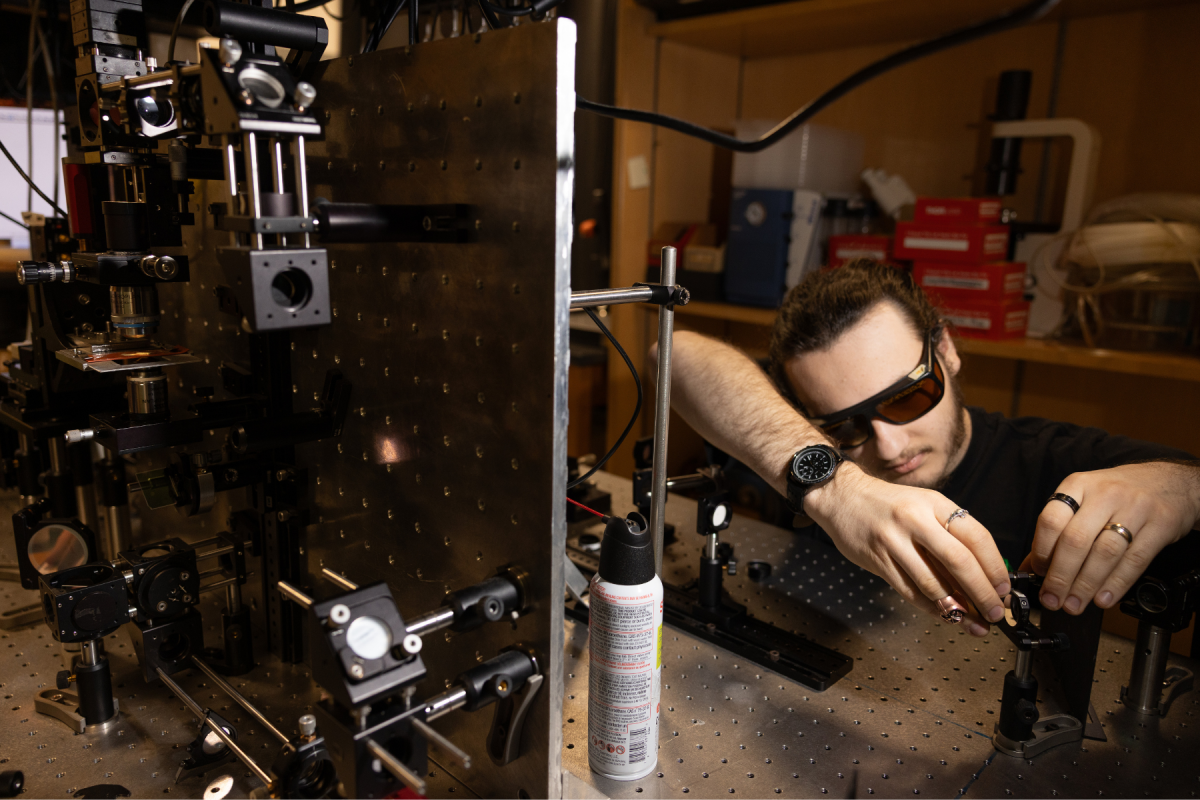
Junior physics major Joshua Lennon, of Greensboro, optimizes the spectrometer in the Laser Tweezers Raman Spectroscopy system. Photo by Chase Reynolds
Senior physics and mathematics major Asher Rockriver, of Pittsboro, sought out research opportunities during his sophomore year and connected with Hester about joining the lab’s Raman spectroscopy project, which was especially interesting to him. Rockriver works with the LTRS system, focusing on enhancing its alignment and efficiency to improve the signals that it detects. He also develops procedural documentation and assists with reviewing and editing grant proposals for the group.
Rockriver is drawn to Raman spectroscopy because of both its scientific applications and its underlying physics. He shared, “Through the technique you can theoretically find out the exact makeup of a sample without damaging it at all, or needing to react with it chemically. At the same time, the reason we are able to use the technique is due to the quantum behaviors of molecules and light, which is also super cool to me.”
Rockriver, who plans to pursue graduate study after graduating from App State, said the research experience he has gained in BiyOSeF will be valuable as he moves into future research roles.
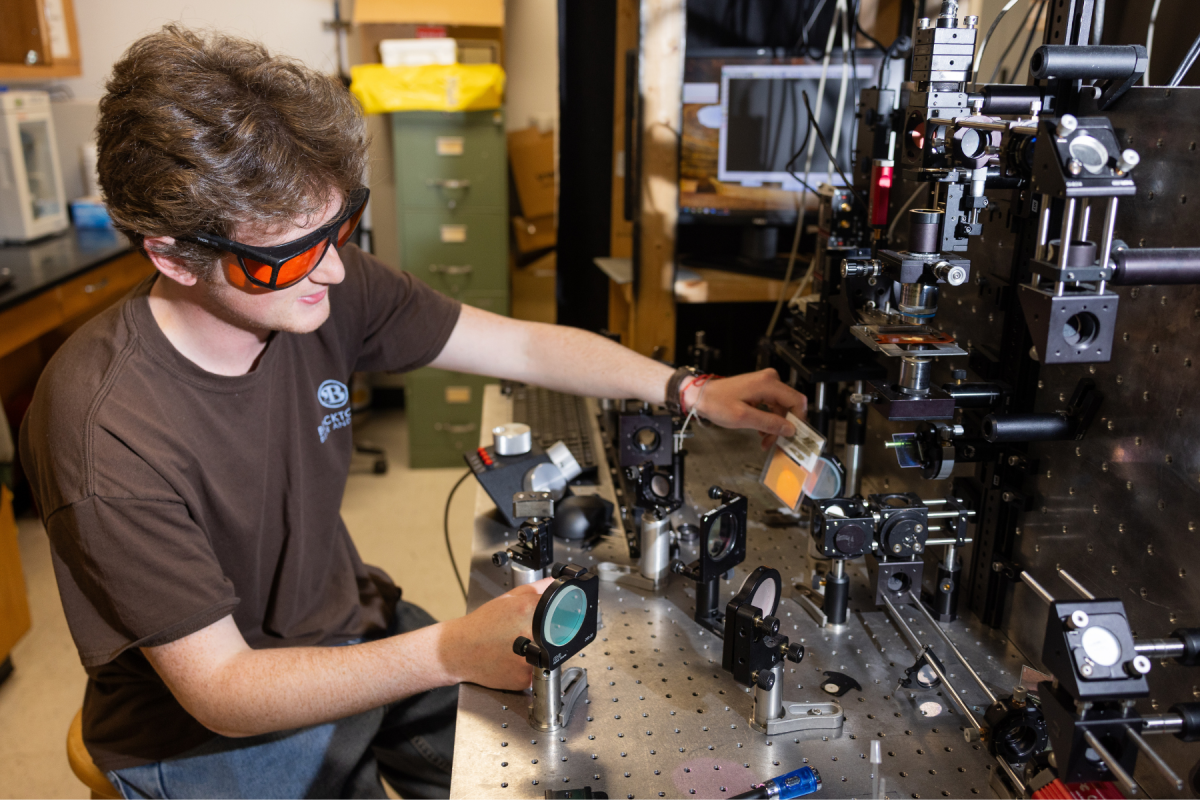
Senior physics and mathematics major Asher Rockriver, of Pittsboro, demonstrates the Raman excitation laser beam alignment procedure he developed for the Laser Tweezers Raman Spectroscopy system. Photo by Chase Reynolds
The work by these four undergraduate students demonstrates the access App State provides to mentored research experiences typically reserved for graduate students, and the meaningful impact those experiences have on students’ development. “In the BiyOSeF lab, I have not only been able to build my understanding of physics, but also of myself, what I’m interested in, and what I am capable of doing,” said Rockriver.
###
About the Department of Physics and Astronomy
The Department of Physics and Astronomy’s curriculum has an applied nature that includes a core of fundamental physics courses and laboratory experiences. The department prepares graduates for a variety of scientific, teaching or engineering professions, as well as future educational endeavors. Learn more at physics.appstate.edu.
About the College of Arts and Sciences
The College of Arts and Sciences (CAS) at Appalachian State University is home to 17 academic departments, two centers and one residential college. These units span the humanities and the social, mathematical and natural sciences. CAS aims to develop a distinctive identity built upon our university's strengths, traditions and locations. The college’s values lie not only in service to the university and local community, but through inspiring, training, educating and sustaining the development of its students as global citizens. More than 6,800 student majors are enrolled in the college. As the college is also largely responsible for implementing App State’s general education curriculum, it is heavily involved in the education of all students at the university, including those pursuing majors in other colleges. Learn more at cas.appstate.edu.
By Lauren Gibbs
April 8, 2026
BOONE, N.C.
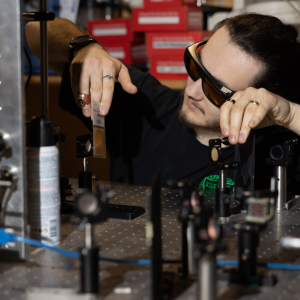
A man wearing goggles holds a card in front of a sensor.
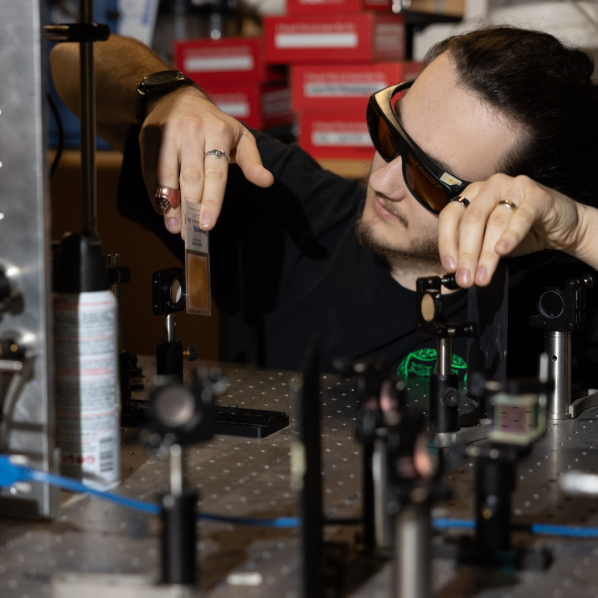
Junior physics major Joshua Lennon, of Greensboro, calibrates an instrument in the Biophysics and Optical Sciences Facility (BiyOSeF). Photo by Chase Reynolds