
BOONE, N.C. — Vanya Dill, a senior geology major from Morrisville, has been invited to present her research at The 122nd Explorers Club Annual Dinner: Odysseys on April 18 in New York City. The annual black-tie gala brings together over 1,000 members of The Explorers Club, a multidisciplinary professional society dedicated to advancing field research, scientific exploration and resource conservation.
Dill will share findings from her project, “Volcanism in the Central Asian Orogenic Belt during the Late Devonian and its Impacts on Local Marine Communities.” Dill received a Rising Explorer Grant from The Explorers Club to support her travel to Mongolia in August 2025. The grant program helps high school and undergraduate students turn their scientific ideas into real‑world field research. The eighth App State student to receive such a grant, Dill was the only Rising Explorer Grant awardee selected to present her results.
Her work focuses on volcanic rocks in southern Mongolia formed during the Devonian Period (419–358 million years ago). A major mass extinction event — one of the “Big Five” extinction events in Earth’s history — occurred in the Late Devonian, but its causes remain unclear. Dill’s research aims to better understand the region's volcanic activity and how it may have impacted marine communities leading up to the extinction.
"The rocks found in modern-day southern Mongolia were a part of a volcanic island arc system within the Central Asian Orogenic Belt during the Devonian," explained Dill. She noted that the region is understudied and that limited information about the paleoenvironment makes it difficult to distinguish local volcanic or tectonic stressors from global extinction signals. "Understanding the local volcanics is a crucial step in understanding the stresses placed on local marine communities, which may be different from global stresses contributing to the Late Devonian mass extinctions," she said.
By analyzing trace elements and mineral compositions in the volcanic rocks, Dill is contributing new geochemical data that may provide additional information about the environment of these island arcs throughout the Devonian, as well as how these arcs evolved over time.
Dill's work is advised by Dr. Sarah Carmichael, professor in App State's Department of Geological and Environmental Science (GES). Carmichael is a Fellow of The Explorers Club, a National Geographic Explorer, and one of the 2022 Explorers Club 50. She and GES Faculty Emeritus Dr. Johnny Waters lead the Devonian Anoxia, Geochemistry, Geochronology, and Extinction Research (DAGGER) group, an interdisciplinary, international team studying the systematics of Late Devonian mass extinctions.
“Vanya’s rocks from the 2025 expedition to Mongolia have never before been studied; there was essentially nothing known about this region aside from some paleontological canvassing that was done during the Soviet expeditions in the 1970s,” explained Carmichael. “Her work is the first to study the volcanic rocks of the region.”
Dill, a member of App State's Honors College, first connected with Carmichael while searching for a senior honors thesis project. "We decided that I would focus on exploring and synthesizing the volcanic material collected by the DAGGER group in Mongolia," shared Dill. "We would see what we found when we started analyzing these rocks since we had absolutely no idea and go from there."
In addition to her Rising Explorer grant, Dill also received a College of Arts and Sciences Student And Faculty Excellence (SAFE) Fund grant to join the DAGGER group in Mongolia and sample volcanic rocks, work that contributed to the project she'll present on April 18. Her research will also contribute to a forthcoming peer‑reviewed scientific publication.
This May, Dill will graduate from App State with her bachelor’s degree in geology, concentrating in quantitative geosciences and minoring in mathematics. She hopes to apply the skills she’s gained as an undergraduate researcher to a master’s program in geophysics in the future.
###
About the Department of Geological and Environmental Sciences
Located in Western North Carolina, Appalachian State University provides the perfect setting to study geological and environmental sciences. The Department of Geological and Environmental Sciences provides students with a solid foundation on which to prepare for graduate school or build successful careers as scientists, consultants and secondary education teachers. The department offers six degree options in geology and two degree options in environmental science. Learn more at earth.appstate.edu.
By Lauren Gibbs
March 19, 2026
BOONE, N.C.
Vanya Dill, a senior geology major from Morrisville, at a field site in Mongolia in August 2025. Photo by Dr. Sarah Carmichael
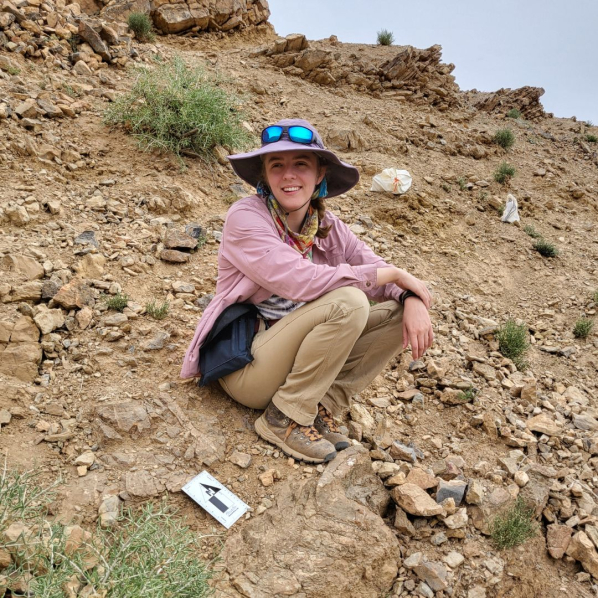
Vanya Dill, a senior geology major from Morrisville, at a field site in Mongolia in August 2025. Photo by Dr. Sarah Carmichael