
BOONE, N.C. — Students in Appalachian State University's Robotics Lab (YeRo Lab) are exploring how robots can learn, adapt, and collaborate with humans in dynamic environments.
Led by Dr. Yeganeh Madadi, assistant professor in the Department of Computer Science, the lab combines research in robotics, artificial intelligence, and machine learning while providing students with opportunities to participate in research projects and technology development. The establishment of the Robotics Lab and the development of the Introduction to Robotics course were supported in part by two College of Arts and Sciences (CAS) opportunities: the Billy and Del Hunt Helton Faculty Excellence Fund and a CAS Research/Proposal Development Summer Grant.
The lab officially opened in summer 2025, creating new opportunities for students to participate in robotics research. Since then, the YeRo Lab has expanded its research activities and increased student involvement while exploring new approaches to human-robot interaction.
Current projects focus on helping robots better understand and respond to the people around them. Researchers are investigating how robots can adapt their behavior over time, work safely alongside people, and use different types of information to make more informed decisions.
Students work with a variety of robotic platforms. In the video below, a GO2 quadruped robot, often called a "robot dog," demonstrates how four-legged robots can navigate spaces while maintaining balance. Other projects feature robotic arms that handle objects, humanoid robots designed to interact with people, and mobile robots that can move through an environment while manipulating objects.
One research area examines how robots can adjust their actions as people move nearby, an important challenge in workplaces where humans and robots share the same space. The video below includes a demonstration of a robotic arm transferring an object between locations on a workbench, illustrating the kinds of questions researchers are exploring.
The lab also uses humanoid robots, including Pepper and NAO, to study how people and robots communicate and work together. These platforms help students explore how robot behavior, movement, and communication influence interactions with people.
Beyond research, the YeRo Lab emphasizes experiential learning. Students participate in experiments, develop algorithms, analyze data, and contribute directly to ongoing projects. To further strengthen robotics education at App State, Madadi has developed three courses in the Department of Computer Science: Introduction to Robotics, Robot Modeling and Control, and Machine Learning in Robotics. These courses provide students with foundational and advanced knowledge in robotic systems, motion modeling, control algorithms, and machine learning applications, connecting classroom instruction with hands-on research opportunities in the YeRo Lab.
"Our students' curiosity, creativity, and dedication are essential to the progress of our research," said Madadi. "One of the most rewarding aspects of leading the lab is watching students take ownership of challenging research questions, learn through experimentation, and grow into independent researchers."
Watch a behind-the-scenes look at the YeRo Lab:
###
About the Department of Computer Science
Appalachian’s Department of Computer Science provides a rigorous, high-quality education that prepares students for the computing industry or graduate education. It offers a Bachelor of Science degree in computer science, which is accredited by the Computing Accreditation Commission of ABET, and a Master of Science degree in computer science. Learn more about the Department of Computer Science
About the College of Arts and Sciences
The College of Arts and Sciences (CAS) at Appalachian State University is home to 17 academic departments, two centers and one residential college. These units span the humanities and the social, mathematical, and natural sciences. CAS aims to develop a distinctive identity built upon our university's strengths, traditions and locations. The college’s values lie not only in service to the university and local community, but through inspiring, training, educating, and sustaining the development of its students as global citizens. More than 6,800 student majors are enrolled in the college. As the college is also largely responsible for implementing App State’s general education curriculum, it is heavily involved in the education of all students at the university, including those pursuing majors in other colleges. Learn more about CAS
By Lauren Gibbs & Dr. Yeganeh Madadi
October 28, 2026
BOONE, N.C.
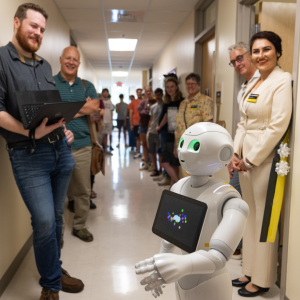
A white humanoid robot with glowing green eyes stands in a hospital hallway as staff line the corridor, smiling and watching with warm curiosity.
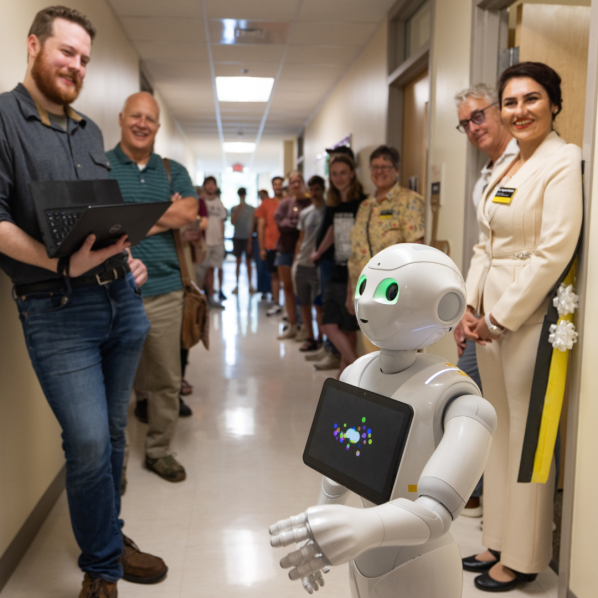
Members of the YeRo Lab demonstrate how a humanoid robot can assist children with their communication skills during the Robotics Lab opening celebration on June 25, 2025. Photo by Chase Reynolds