
BOONE, N.C. — In many undergraduate laboratory courses, students conduct experiments with expected outcomes. In Dr. Clare Scott Chialvo’s Genomics: DNA to Gene ID (BIO 3400) course at Appalachian State University, students instead use real genomic data to investigate research questions.
For 13 undergraduate students, that work has led to first-author scientific publications.
BIO 3400 is designated as a Course-based Undergraduate Research Experience, or CURE, meaning students learn through participation in authentic research rather than traditional laboratory exercises with predetermined results. In the course, students develop coding and bioinformatics skills and apply them to an ongoing research project.
Chialvo, an associate professor in App State’s Department of Biology, studies evolutionary biology and entomology. Her Mushroom Fly Lab investigates how mushroom-feeding Drosophila, or fruit flies, evolved the ability to tolerate toxins found in mushrooms that are dangerous to many other organisms.
In BIO 3400, students contribute to related genomic research. Using an adapted protocol from the Genomics Education Partnership, they analyze genomic evidence to identify and characterize genes in different Drosophila species, helping determine where particular genes are located, what they look like, and how they compare across species. Together, their findings contribute to research on the evolution of detoxification gene families.
That research has resulted in 13 first-author publications by App State undergraduate students in 2026:
Parker Brooks developed a model for the dib gene in Drosophila cardini.
Jadon Bumgarner developed a gene model for GstO3 in Drosophila immigrans.
Camille Canard developed a model for JhI-26 and a related gene, or paralog, in Drosophila dunni.
Summer Dieterle developed a gene model for ABCB7 in Drosophila funebris.
Hope Freshwater developed a gene model for yellow-f2 in Drosophila dunni.
Taneille Jordan developed a gene model for CG31087 in Drosophila arawakana.
Brianna Lowry developed a gene model for gfzf in Drosophila cardini.
Braiden McAlpin developed a gene model for snu in Drosophila funebris.
Molly McDonald developed a gene model for PGRP-SB1 in Drosophila funebris.
Stephen Moxley developed a gene model for Cyp6a14 in Drosophila cardini.
Payal Patel developed a model for the sad gene in Drosophila cardini.
Brenna Peruso developed a gene model for Wnt6 in Drosophila cardini.
Emma Williams developed a gene model for GstO3 in Drosophila dunni.
All 13 publications are co-authored by Dr. Pablo Chialvo, a teaching associate professor in the Department of Biology, and Dr. Clare Scott Chialvo. The studies were published in microPublication Biology, an open-access, peer-reviewed scientific journal that publishes concise research findings.
For students in BIO 3400, the course provides an opportunity to move beyond learning about scientific research to actively contributing to it, gaining hands-on skills and experience that can serve them in graduate school and their future careers.
###
About the Department of Biology
The Department of Biology is a community of teacher-scholars, with faculty representing the full breadth of biological specializations — from molecular genetics to landscape/ecosystem ecology. The department seeks to produce graduates with sound scientific knowledge, the skills to create new knowledge, and the excitement and appreciation of scientific discovery. Learn more about the Department of Biology
By Lauren Gibbs
October 1, 2026
BOONE, N.C.
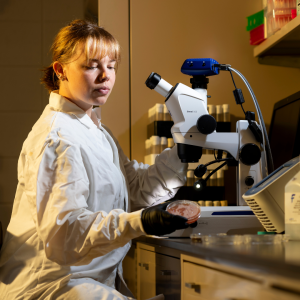
A woman in a lab coat examines a petri dish while seated at a laboratory bench with a microscope and various lab equipment.
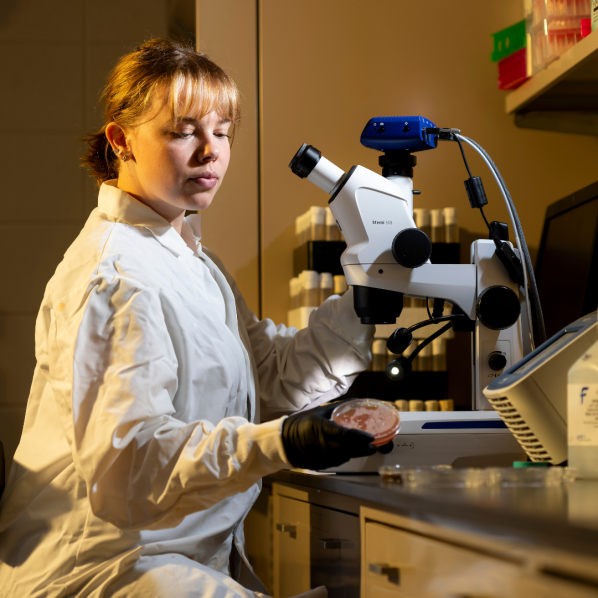
Biology graduate student Haley Martin ’23 ’25 conducts research on fruit flies in Dr. Clare Scott Chialvo's lab. Photo by Kyla Willoughby