
Mountaineer Discovery: This story is part of a series highlighting student research, creativity and innovation at App State. Join the Office of Student Research for the 29th annual Celebration of Student Research and Creative Endeavors on Wednesday, April 22.
Worldwide, more than 80 million people suffer from glaucoma, the second leading cause of blindness behind cataracts. Half of sufferers don’t know they have it, and by the time they do, their vision has been irreparably damaged.
With a goal of helping medical professionals get ahead of the problem, App State students Michael Sciole ‘24 and Jake Jenkins ‘25 are using artificial intelligence to seek out genetic indicators of the disease and tapping machine learning to improve imagery analysis geared to early detection.
While their work focuses on glaucoma detection, similar models could assist in the early detection of cancer and other diseases.
Glaucoma meets AI
Sciole, a graduate student in the Department of Computer Science, has built a computer model network using four machine learning algorithms enhanced by AI to better identify the genetic biomarkers associated with glaucoma — information aimed at helping doctors predict hereditary risk for the disease and begin intervention early.
“Doctors and pathologists can take our model and perform genetic analysis to find new biomarkers never before seen,” said Sciole, who is from Winston-Salem.
The ensemble network — an architecture composed of multiple machine learning models — focuses on retinal ganglion cells, the cells in the eye that process visual signals, and their genetic datasets obtained through RNA sequencing. The system is capable of analyzing vast amounts of data with a goal of identifying the biomarkers, or genetic features, connected with the disease.
While similar models are too big to be run on many computers, Sciole says his project is lightweight, accessible for lab use in a wide range of settings, and simple enough to run on a laptop. The model has an impressive level of accuracy compared to competitors, Sciole noted, and he hopes its versatility could help the model become widely adopted at the emerging intersection of AI and medicine.
“My goal is to have laboratories take this model and run retinal ganglion cell datasets on it and find new biomarkers whose presence helps indicate a decade in advance, for example, that someone is going to develop glaucoma and they should start worrying about that now,” Sciole said. “That can put control back in the patient’s hands and save their eyes.”
Sciole, who plans to pursue a doctorate in bioinformatics, is advised by Dr. Yeganeh Madadi, assistant professor in the Department of Computer Science. He and Madadi are working on a related paper to submit to academic journals — a key step toward the goal of getting the model noticed, validated by researchers, and eventually used by health care professionals.
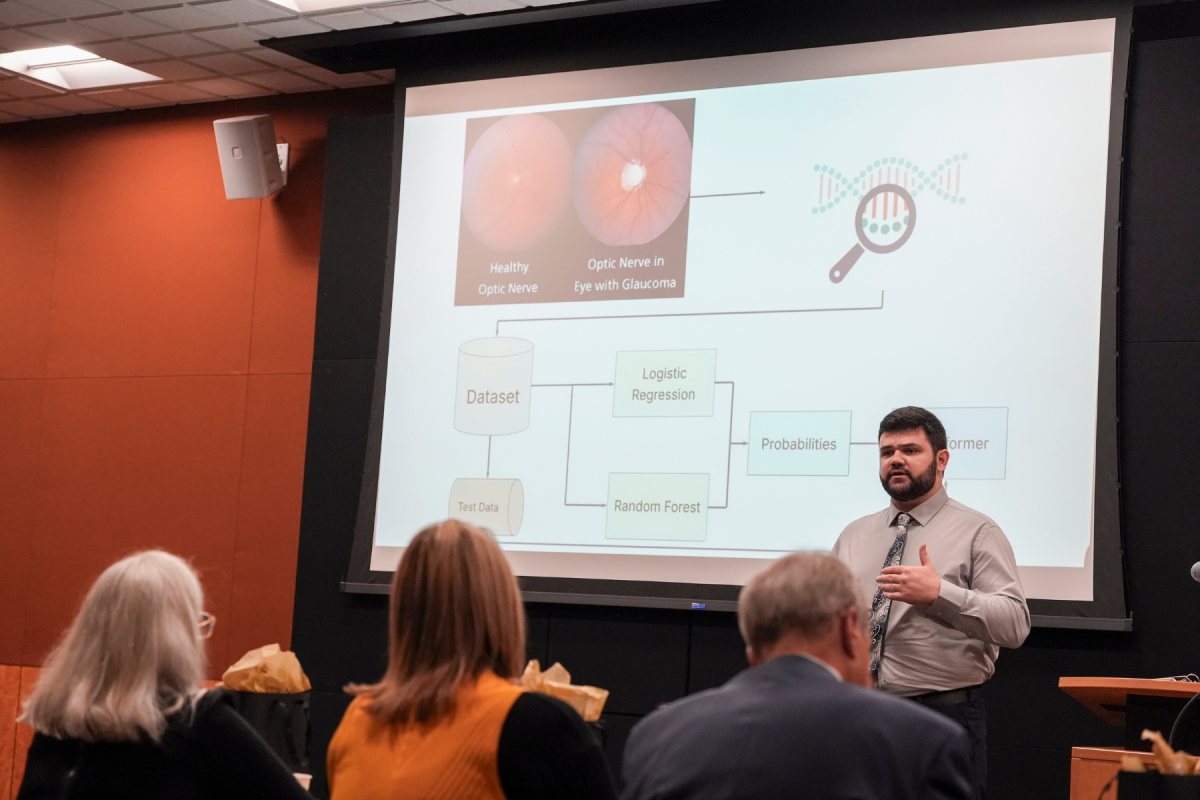
Michael Sciole ’24 presents his master's thesis, "Transemble: A Transformer Ensemble Network for Detecting Retinal Ganglion Cell Types," at App State's 14th annual Three Minute Thesis competition on Friday, November 21, 2025. Photo by Troy Tuttle
Improving glaucoma image analysis
Jenkins, who is pursuing a master's degree in data science, is using ensemble learning models to analyze images of the human eye for subtle differences that indicate glaucoma risk. The method converts two-dimensional medical images into a one-dimensional data sequence for analysis, combining outputs from three different models to improve accuracy based on image characteristics. The models are trained on a database with thousands of images of the human retina, and their effectiveness stems from the fact that each model is trained separately—in essence creating multiple independent minds focused on a single problem.
“The goal of the ensemble is that it performs better than any one individual model,” Jenkins explained.
The improved accuracy of coordinated models can benefit detection processes not only for glaucoma but also for other diseases where early awareness is critical, Jenkins noted. He hopes to hasten a day when patients can easily get access to automated vision evaluation systems that arm them with knowledge sooner, more quickly, and with less difficulty and expense than current methods.
“Envision a world where you don't have to go to the eye doctor,” he said. “Instead, you can go to a screening similar to breast cancer screening, improving access for millions of people who would otherwise become blind.”
Jenkins, of Kure Beach, is advised by Dr. Mohammed Ali Javidian, assistant professor in the Department of Computer Science.
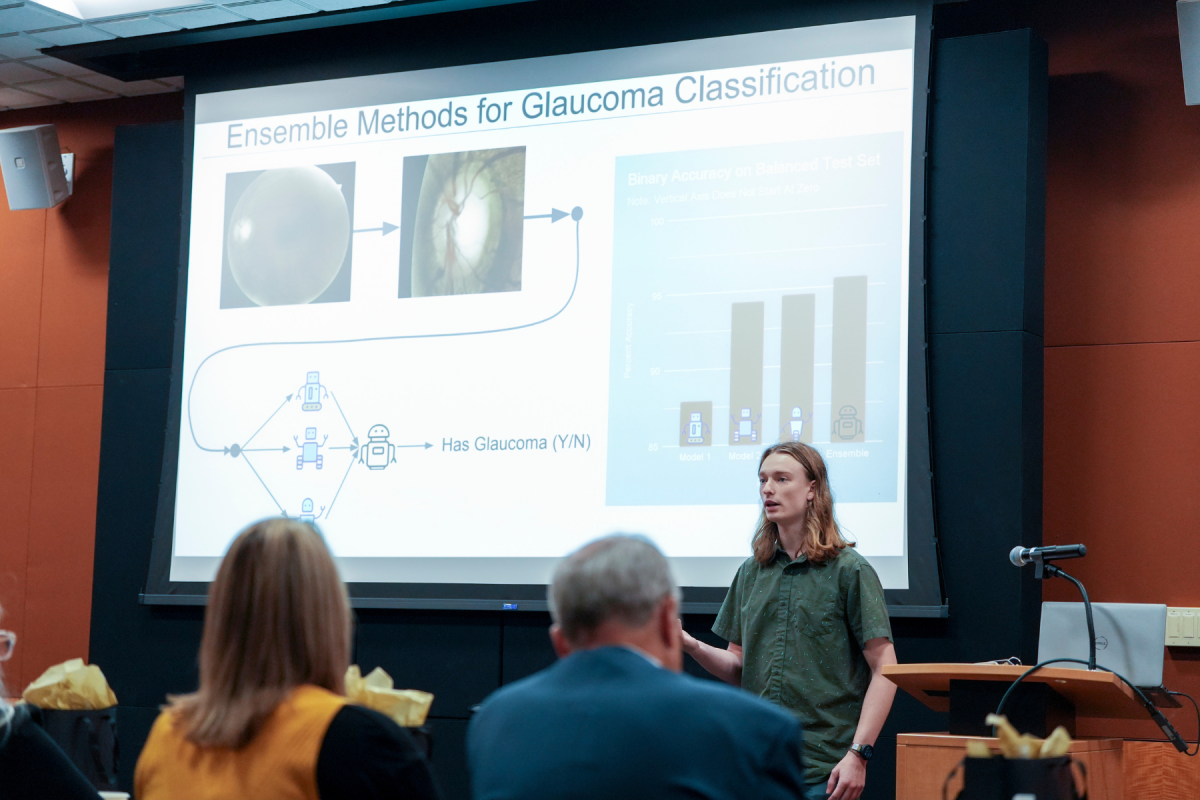
Jake Jenkins ’25 presents his master's thesis, "Glaucoma Classification using Ensemble Learning," at App State's 14th annual Three Minute Thesis competition on Friday, November 21, 2025. Photo by Troy Tuttle
###
About the Department of Computer Science
Appalachian’s Department of Computer Science provides a rigorous, high-quality education that prepares students for the computing industry or graduate education. It offers a Bachelor of Science degree in computer science, which is accredited by the Computing Accreditation Commission of ABET, and a Master of Science degree in computer science. Learn more at compsci.appstate.edu.
About the College of Arts and Sciences
The College of Arts and Sciences (CAS) at Appalachian State University is home to 17 academic departments, two centers and one residential college. These units span the humanities and the social, mathematical and natural sciences. CAS aims to develop a distinctive identity built upon our university's strengths, traditions and locations. The college’s values lie not only in service to the university and local community, but through inspiring, training, educating and sustaining the development of its students as global citizens. More than 6,800 student majors are enrolled in the college. As the college is also largely responsible for implementing App State’s general education curriculum, it is heavily involved in the education of all students at the university, including those pursuing majors in other colleges. Learn more at cas.appstate.edu.
By Bret Yager
March 24, 2026
BOONE, N.C.
The Department of Computer Science logo featuring the block A with two lines of text underneath it: The first line reads "College of Arts and Sciences," and the second line reads "Computer Science."
The Department of Computer Science in the College of Arts and Sciences at Appalachian State University