
BOONE, N.C. — In May, Appalachian State University biology students — joined by students from the University of North Carolina Asheville — traveled more than 5,000 miles across the American Southwest as part of an immersive Desert Ecology field course.
Over three weeks, students explored the Sonoran and Chihuahuan deserts, Sky Islands within the mountains, White Sands National Park, Guadalupe Mountains National Park, and Big Bend National Park while investigating how plants, animals, and entire ecosystems have adapted to some of North America’s most extreme environments. The trip was co-led by Dr. Matt Estep, professor and honors program director in App State's Department of Biology, along with Dr. Jonathan Horton and Dr. Chris Nicolay, professors in UNC Asheville's Department of Biology.
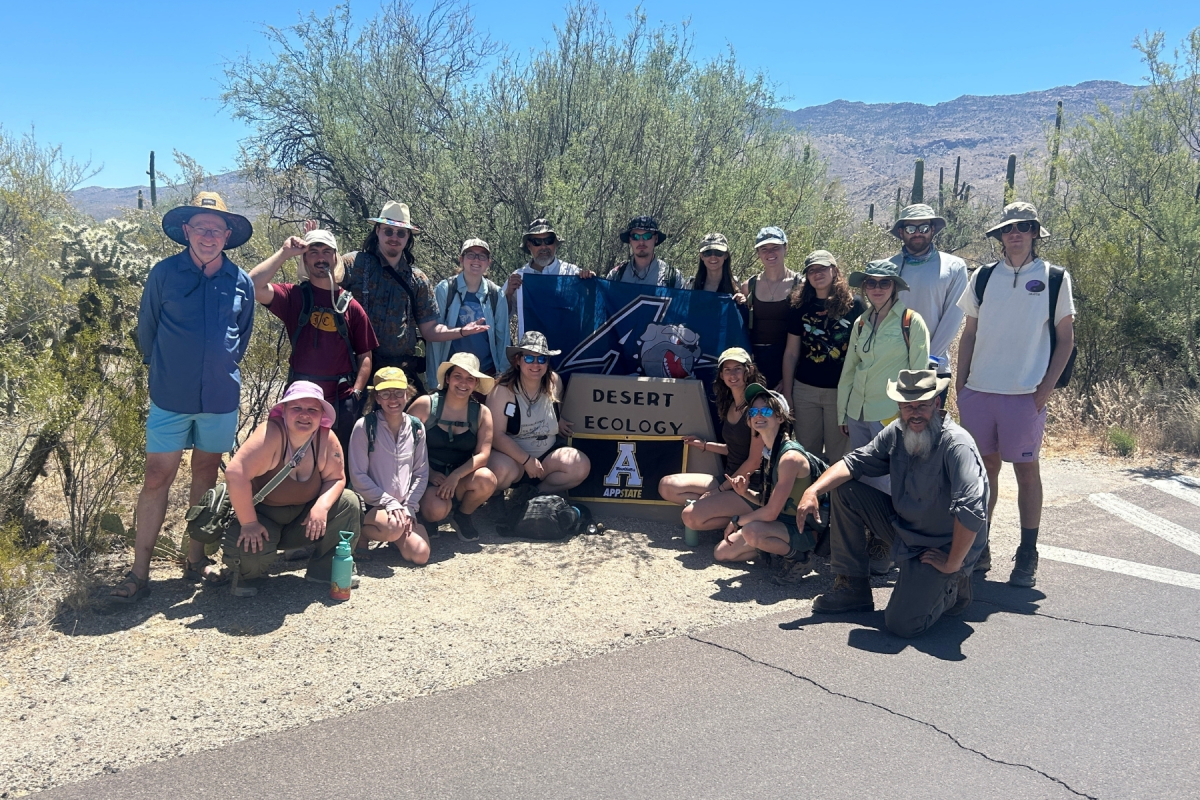
The App State and UNC Asheville groups proudly display their university flags at the Desert Ecology Trail in Saguaro National Park (Tucson, AZ). Photo by Matthew Heavner
Estep shared that rather than learning ecology solely in a classroom, students experienced it firsthand through daily field observations, scientific journaling, species identification, and field presentations. From towering saguaros and resilient desert wildflowers to reptiles, mammals, and birds uniquely adapted to arid landscapes, the course emphasized learning through direct observation and inquiry. The expedition challenged students to connect geology, climate, biodiversity, and conservation while developing the field skills used by practicing ecologists.
Watch the recap video about the trip by honors biology student Jade Hickerson:
###
About the Department of Biology
The Department of Biology is a community of teacher-scholars, with faculty representing the full breadth of biological specializations — from molecular genetics to landscape/ecosystem ecology. The department seeks to produce graduates with sound scientific knowledge, the skills to create new knowledge, and the excitement and appreciation of scientific discovery. Learn more about the Department of Biology
Written by Dr. Matt Estep
Edited by Lauren Gibbs
July 27, 2026
BOONE, N.C.
A group of people standing in a desert setting beside a sign reading "Desert Ecology." The group is holding flags featuring the Appalachian State and UNC Asheville logos.
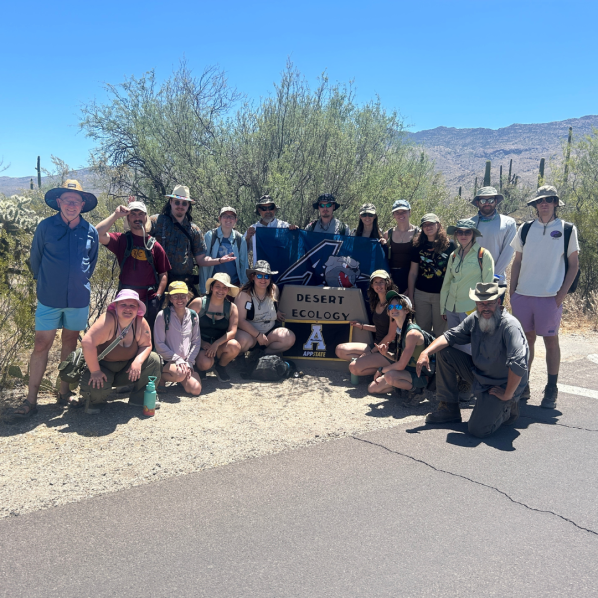
The App State and UNC Asheville groups proudly display their university flags at the Desert Ecology Trail in Saguaro National Park (Tucson, AZ). Photo by Matthew Heavner